FREE collection from Watford

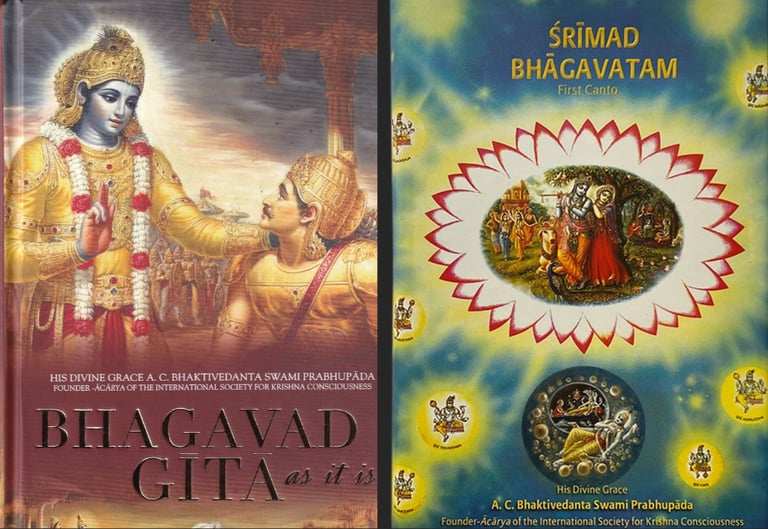
Bhagavad Gita Vs Srimad Bhagavatam
5/2/20262 min read
These are two of the most revered texts in Hindu philosophy, but they differ significantly in nature, scope, authorship context, and purpose. Below we can elaborate further:
Basic Identity:
Alternative names: Bhagavad Gita is also called Gitopanishad. Srimad Bhagavatam is called Bhagavat Purana.
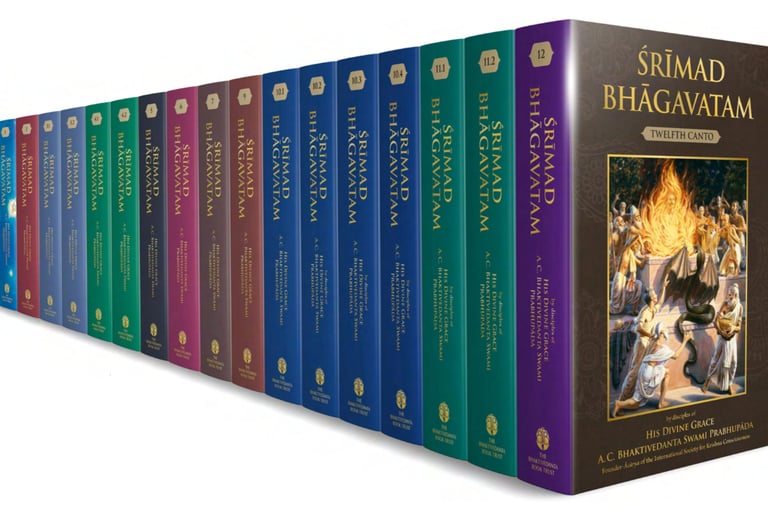
Length: Bhagavat Gita has 700 slokas. Srimad Bhagavatam has 12 skandas (cantos), and about 18,000 slokas
2. Origin & Context
Bhagavad Gita
Embedded within the Mahabharata (Bhishma Parva), composed by Vyasa.
Takes place on the battlefield of Kurukshetra, just before the war between the Pandavas and Kauravas.
It is a direct conversation between Lord Krishna and Arjuna, lasting only the brief moments before battle began.
Arjuna's grief and moral confusion about fighting his own kin serves as the trigger.
Srimad Bhagavatam
A standalone Mahapurana, also attributed to Veda Vyasa, composed after the Mahabharata.
Vyasa felt unfulfilled even after compiling the Vedas and Mahabharata, and was inspired by Narada Muni to compose a work purely devoted to the glory of Bhagavan (God).
Its primary narration is by Shuka dev Goswami to King Parikshit, who had only 7 days to live after being cursed.
The setting is a spiritual discourse in a forest, calm and contemplative.
3. Central Theme and Purpose
Bhagavad Gita
Primarily a text of practical and philosophical instruction.
Aims to resolve Arjuna's immediate crisis and teach him his duty (Dharma).
Covers Karma Yoga (path of action), Jnana Yoga (path of knowledge), and Bhakti Yoga (path of devotion) in an integrated framework.
Answers the question: "How should a human being live and act in this world?"
Srimad Bhagavatam
Primarily a text of devotion and divine narrative (Bhakti).
Its goal is the complete liberation of the soul through loving surrender to Krishna.
Filled with stories, cosmology, philosophy, and theology — it goes far beyond ethical instruction.
Answers the question: "Who is God, what is His nature, and how can the soul return to Him?"
4. Philosophical emphasis
Bhagavad Gita
Deals deeply with nature of soul vs. matter, Yoga, Karma, Guna theory (three modes of nature), and the concept of Nishkama Karma (desireless action).
Covers multiple paths to liberation — Karma, Jnana, and Bhakti.
Culminates in the teaching of Sharanagati (total surrender) in the final verse (18.66).
More universally applicable — addressed to all of humanity through Arjuna.
Srimad Bhagavatam
Devotion to Vishnu/Krishna. Explains about supreme.
Covers , cosmology, creation, destruction, the nature of time (Kala), and the lives of great devotees.
Contains the famous Dashavatara (ten avatars of Vishnu) stories in great detail.
The 10th Canto (dedicated to Krishna's life) is considered the crown jewel
Introduces the concept of Navavidha Bhakti — nine forms of devotional service.
5. Structure
Bhagavad Gita — 18 Chapters covering:
Arjuna's despair → Soul & body distinction → Karma Yoga → Jnana Yoga → Renunciation → Bhakti → Divine & demoniac natures → Ultimate surrender
Srimad Bhagavatam — 12 Cantos (Skandhas) covering:
Canto 1–3: Creation, Vishnu's form, philosophical foundations
Canto 4–5: Stories of devotees, cosmology
Canto 6–7: Prahlada's story, Narada's teachings
Canto 8–9: Gajendra Moksha, Avatars, royal dynasties
Canto 10: Krishna's complete life story (most celebrated)
Canto 11: Krishna's final instructions (often called the "Uddhava Gita")
Canto 12: Kali Yuga prophecies, final liberation of Parikshit
Explore ancient wisdom for inner peace.
© 2025. All rights reserved.
BE SPIRITUAL